Chiropractor for Kids & Teens Toronto, Core Wellness Centre

At a glance: Core Wellness Centre offers chiropractic assessments for children and teens with back pain, neck discomfort, sports-related strains or restricted movement. Every visit starts with a conversation and an examination, and an assessment doesn’t automatically lead to treatment.
Depending on the findings, the next step may be advice, a discussion of care options, monitoring, or a referral to your child’s doctor or another provider.
No referral is needed to book, and our clinic is on St. Clair Avenue West in Toronto.
When your child or teen is uncomfortable, you want clear answers and a sensible plan. This page explains who we see, what happens at an appointment, how care decisions are made, how consent works in Ontario, and when it’s better to see a doctor first. If you have a question that isn’t answered here, please call us at (416) 479-8311.
Who we see
We assess school-aged children and teenagers with muscle, joint and spine-related concerns. That may include teen athletes, busy students, and kids recovering from a minor sports or recreational injury.
For infants, please call the clinic before booking. You’ll find more about infant assessments below.
Common concerns families ask about
Kids and teens can feel muscle and joint discomfort from school, sports and everyday life. Parents often contact us about:
- Back or neck pain that lingers or keeps coming back
- Muscle or joint discomfort that limits everyday activities
- Pain or stiffness after a sports or recreational injury
- Discomfort while sitting, studying, using screens or carrying school bags
None of these signs is a diagnosis, and none of them means chiropractic treatment is needed. Children aren’t simply smaller adults: paediatric research notes that some causes of spinal pain are specific to growing bodies, which is why a careful history and examination matter. Please don’t assume that ongoing pain is just part of growing up, and if you’re unsure where to start, your child’s family doctor is always a good first call.
Chiropractic assessments for infants
Babies aren’t simply small children, and caring for them calls for extra time, care and caution. That’s why we ask parents to call the clinic before booking an appointment for an infant. A short conversation helps us understand your concern and whether a chiropractic assessment is the right place to start.
When parents ask about an assessment
Parents sometimes contact us when their baby seems to prefer turning their head to one side, or seems uncomfortable in certain positions. Concerns like these should also be raised with your baby’s doctor, who can rule out other causes and advise on the right care, which may include physiotherapy.
A chiropractic assessment for an infant focuses only on muscles, joints and movement. It isn’t a substitute for your baby’s regular check-ups with their doctor.
What an infant assessment involves
If an assessment is appropriate, Dr. Kris will start with a detailed conversation about your baby’s history, including pregnancy and birth, feeding, sleep, movement and any advice you’ve already received from other providers. Any examination is explained to you first, and you stay with your baby throughout.
The findings guide the next step. That may be advice for home, monitoring, a referral back to your baby’s doctor or another provider, or a discussion of care options. Any proposed care is explained in full, including its expected benefits, risks and alternatives, and nothing proceeds without your informed consent as your baby’s substitute decision-maker. You can ask questions or stop at any time.
Concerns that belong with your baby’s doctor
Please speak with your baby’s doctor or primary healthcare provider about feeding difficulties, persistent crying, sleep concerns, illness, or questions about growth and development. These are not concerns a chiropractic assessment is designed to address.
Get medical care right away if your baby:
- Has a fever and is under three months old
- Has trouble breathing, or is unusually sleepy, floppy or hard to wake
- Is feeding poorly, vomiting forcefully, or has noticeably fewer wet diapers
- Has a stiff neck, or a new rash with a fever
- Has a high-pitched or very different cry, or seems to be in significant pain
Call 911 if your baby needs emergency help.
What happens at the first appointment?
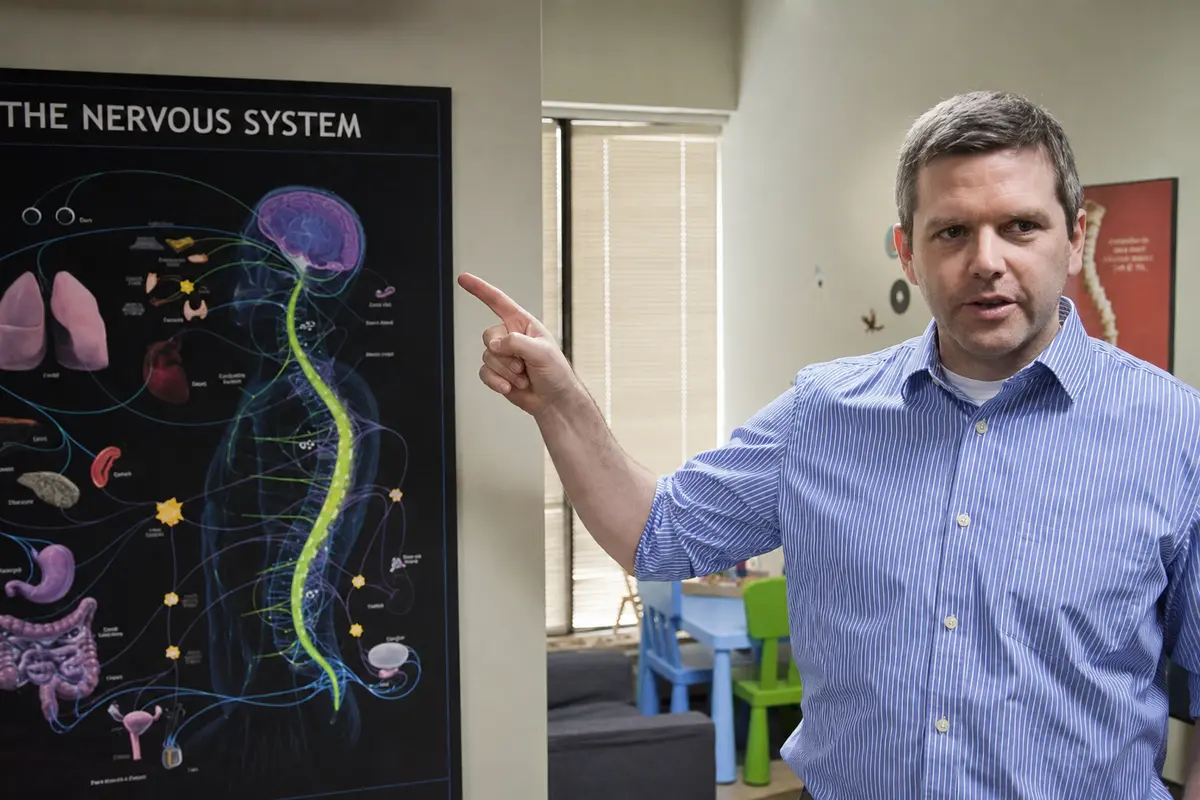
At Core Wellness Centre, new patients begin with our Clinic Director, Dr. Kris Dorken, DC. Dr. Kris is registered to practice as a chiropractor in Ontario and is a member of the College of Chiropractors of Ontario.
The visit starts with a conversation, not a treatment table. Dr. Kris will ask when the concern started, whether there was an injury, what makes it better or worse, and how it’s affecting school, sleep, sports or time with friends.
Your child’s own voice matters here. Depending on their age and comfort level, they’ll have the chance to describe what they feel in their own words and ask their own questions. Their description often adds details that help guide the assessment.
If an examination is appropriate, Dr. Kris will explain what it involves before he begins. It may include watching how your child moves, checking the relevant joints and muscles, and other tests guided by their history and symptoms.
The findings shape what happens next. That could be practical advice, a discussion of care options, further investigation, or a referral to another healthcare provider. Read more about what to expect at your first appointment.
How are care recommendations made?
A good recommendation is built around an identified concern and a clear, practical goal, such as making a specific daily activity more comfortable or improving a movement that’s currently limited.
Care options depend on the assessment findings and on the evidence relevant to your child’s age and condition. Recommendations may include guidance on activity, home exercises, or other care within a chiropractor’s scope of practice. Any hands-on treatment needs its own conversation about whether it’s suitable for your child.
Two things are worth knowing up front. An assessment doesn’t mean your child needs an adjustment, and it doesn’t mean they need ongoing appointments. Because Core Wellness Centre is a multidisciplinary clinic, your child’s needs may also be better met by physiotherapy or registered massage therapy, and we’ll tell you if that’s the case.
There’s also no single plan that suits every child. Research findings vary by age, condition and type of treatment, and evidence from adults shouldn’t automatically be applied to children. If care is recommended, you should hear why, and how progress will be measured.
Before any care begins, you’re welcome to ask:
- What does the proposed treatment involve?
- What benefit can reasonably be expected?
- What risks or limitations apply?
- What are the other options, including monitoring or seeing another provider?
- How and when will progress be reviewed?
Chiropractic care doesn’t replace your child’s regular primary health care or routine developmental check-ups. Learn more about our approach to chiropractic care in Toronto.
Consent and your child’s voice
Informed consent is a conversation, not just a signature. Before any assessment or care, the chiropractor explains what’s proposed, the relevant risks, the expected benefits and the reasonable alternatives, so the person deciding can understand their choices.
Many parents are surprised to learn that Ontario has no fixed age of consent for health care. Under Ontario’s Health Care Consent Act, consent depends on whether the patient can understand the relevant information and appreciate the likely consequences of the decision. A parent or guardian doesn’t automatically make every decision just because their child is under 18.
When a child isn’t able to give valid consent, the chiropractor must obtain it from the appropriate substitute decision-maker, usually a parent or guardian. Even then, your child should get an explanation suited to their understanding and a real chance to share any worries.
If your child feels nervous or uncomfortable at any point, please tell us. Consent can be withdrawn at any time, and questions are always welcome.
When should you see a doctor first?
Some symptoms need medical attention rather than a chiropractic appointment. Knowing them helps you act quickly and confidently.
Get urgent or emergency medical care for:
- A stiff neck together with a fever
- Serious symptoms after a fall, collision or sports injury
- New weakness, numbness or difficulty walking
- Loss of bladder or bowel control
Call 911 if emergency help is needed right away.
Book a visit with your child’s doctor for:
- Pain that persists or keeps getting worse
- Pain that repeatedly wakes your child at night
- Unexplained weight loss, fever or other signs of illness
If you’re unsure how urgent something is, contact your child’s healthcare provider. It’s always okay to check.
Questions parents often ask
Does every child need chiropractic care?
No. Recommendations should respond to your child’s individual concern and assessment findings. Being a certain age or playing sports doesn’t, on its own, mean a child needs treatment.
Is chiropractic care safe for children and teens?
Like any health care, chiropractic care has potential risks as well as potential benefits, and these differ by age, condition and type of care. Before anything begins, Dr. Kris will explain the risks relevant to your child’s situation and the alternatives, so you and your child can make an informed decision.
Can a chiropractor help my teen after a sports injury?
A chiropractor can assess muscle and joint concerns after a sports or recreational injury and discuss whether care, home exercises, a referral or a gradual return to activity makes sense. Serious symptoms after an injury need medical care first (see above). Our clinic also offers sports injury physiotherapy, which may be a better fit for some injuries.
Do I need a referral to book an assessment for my child?
No referral is needed to see a chiropractor in Ontario. Some extended health plans require one for reimbursement, so it’s worth checking your plan.
Will my child receive an adjustment at the first visit?
Not automatically. Dr. Kris first considers the history and examination findings, explains suitable options and obtains informed consent before any treatment.
How many appointments will my child need?
There’s no standard number. If care is recommended, ask how often visits are proposed, when progress will be reviewed and what would lead to a change in the plan.
What should I bring to the appointment?
Bring any relevant reports, a current medication list and details of previous assessments or care. Let us know about recent injuries, ongoing health conditions and any advice your child has already received. You can also complete our new patient forms online before your visit.
Can I book an appointment for an infant?
Please call the clinic before booking so we can discuss the reason for the visit and whether an assessment is appropriate. Concerns about feeding, persistent crying, illness or development should be discussed with your baby’s doctor or primary healthcare provider.
Is chiropractic care for children covered by OHIP or insurance?
OHIP doesn’t cover chiropractic care. Many extended health care plans do, so check whether your child is an eligible dependant and what your plan includes. See chiropractic coverage in Ontario, direct billing and payment options for details, and confirm fees with the clinic before the appointment.
Ask about an appointment at Core Wellness Centre
When your child is uncomfortable, a clear plan helps. If your child or teen has a muscle or joint concern, our team is happy to talk it through and help you find the right appointment type, or the right provider.
Core Wellness Centre
726 St. Clair Avenue West, Toronto, ON M6C 1B3
Phone: (416) 479-8311
Office hours
This page provides general information and does not replace an individual assessment.
Further reading
- Chiropractic Care for Babies and Children: What Toronto Parents Want to Know
- SickKids AboutKidsHealth: Neck pain
- OrthoKids: Back Pain in Children
References
- Evans R, Haas M, Schulz C, Leininger B, Hanson L, Bronfort G. Spinal manipulation and exercise for low back pain in adolescents: a randomized trial. Pain. 2018;159(7):1297–1307. doi:10.1097/j.pain.0000000000001211
- Parnell Prevost C, Gleberzon B, Carleo B, et al. Manual therapy for the pediatric population: a systematic review. BMC Complement Altern Med. 2019;19:60. doi:10.1186/s12906-019-2447-2
- Todd AJ, Carroll MT, Robinson A, Mitchell EK. Adverse events due to chiropractic and other manual therapies for infants and children: a review of the literature. J Manipulative Physiol Ther. 2015;38(9):699–712. doi:10.1016/j.jmpt.2014.09.008
- Hawk C, Schneider MJ, Vallone S, Hewitt EG. Best practices for chiropractic care of children: a consensus update. J Manipulative Physiol Ther. 2016;39(3):158–168. PubMed
- Achar S, Yamanaka J. Back pain in children and adolescents. Am Fam Physician. 2020;102(1):19–28. AAFP