
Whether you are a weekend warrior lacing up your running shoes for the first time this season or a competitive hockey player grinding through a gruelling schedule, back pain is one of the most disruptive injuries an athlete can face.
Back injuries are among the most common sports-related complaints seen by chiropractors and physiotherapists offering athlete back pain treatment. According to research published in the British Journal of Sports Medicine, lower back pain affects up to 30% of athletes across all disciplines, making it the single most reported musculoskeletal complaint in sport.
Yet despite how common it is, many athletes often push through the pain, rely on rest alone, or assume that pain will resolve on its own.
At Core Wellness Centre, our team of chiropractors, physiotherapists and osteopathy practitoners work with athletes at every level to accurately diagnose back injuries, offer athlete back pain treatment, and build a recovery plan designed to get you back to your sport faster, and stronger than before.
In this comprehensive guide, we will walk you through everything you need to know about sports injury and back pain recovery: the most common injuries, sport-specific vulnerabilities, evidence-based treatment options including chiropractic care, Y-strap adjustments, spinal decompression, cold laser therapy, shockwave therapy, and how to build a spine-resilient body for the long term.
Don’t Let Back Pain Get in the Way.
Our athlete back pain treatment is here to help. Book your back pain assessment today. We offer Direct Billing and facilitate claims.
CALL us on (416) 479 – 8311 TODAY or simply book online
The Most Common Sports-Related Back Injuries
Understanding what has gone wrong is the first step toward a successful recovery. Sports-related back injuries generally fall into a few well-defined categories, each requiring a different treatment approach.
Lumbar Muscle Strains and Ligament Sprains

The most frequently encountered back injury in athletes, lumbar strains involve overstretching or tearing of the muscles and tendons that support the lower spine.
These injuries often occur during sudden, forceful movements, a heavy deadlift, an awkward tackle, or a misjudged landing, and symptoms include localized lower back pain, stiffness, muscle spasm, and pain that worsens with movement.
Herniated or Bulging Discs
The intervertebral discs act as shock absorbers between the vertebrae of your spine, and under repeated compressive load or sudden trauma, the soft inner nucleus of the disc can bulge outward or herniate completely through the disc’s outer wall.
In athletes, disc injuries are commonly associated with sports that involve high axial loading, rotation, and repetitive flexion, and so looking for athlete back pain treatment can provide solutions.
Stress Fractures
Stress fractures of the lumbar spine, most commonly at the pars interarticularis (a small bridge of bone in the vertebra), are a significant concern in young, high-volume athletes. This condition is particularly found in sports that involve repeated spinal hyperextension such as gymnastics, swimming, volleyball, and cricket, fast bowling.
When stress fractures occur on both sides of a vertebra, the vertebral body can shift forward, a condition called spondylolisthesis, which can cause significant nerve-related pain and functional impairment.
Sacroiliac (SI) Joint Dysfunction
The sacroiliac joints connect the base of the spine (sacrum) to the pelvis. During athletic activity, asymmetrical loading, repetitive impact, or sudden torsional forces can cause these joints to become misaligned or inflamed.
Thoracic Spine Injuries
While less common than lumbar injuries, the mid-back (thoracic spine) can be affected in athletes who engage in overhead sports, rowing, and contact sports. Thoracic facet irritation, costovertebral joint sprains, and intercostal muscle strains all produce upper or mid-back pain that can limit breathing, rotation, and upper extremity performance.
Acute vs. Overuse Back Injuries in Athletes

Accurate classification of your back injury as either acute or an overuse injury directly shapes the treatment strategy and expected recovery timeline.
Acute injuries occur suddenly, with a clear mechanism – a heavy lift, a collision, a fall, or a sudden twist, and the onset of pain is immediate and usually severe. Acute injuries include muscle tears, ligament sprains, disc herniations from sudden loading, and fractures from direct impact.
Overuse injuries, by contrast, develop gradually over days, weeks, or months. They are the result of repetitive loading that exceeds the body’s capacity to recover between training sessions.
Stress fractures, chronic disc degeneration, and recurring muscle strains are classic overuse presentations. Athletes with overuse injuries frequently report a gradual onset of stiffness or aching that is initially present only during or after activity, before progressing to pain at rest.
Acute injuries often require a modified activity phase and specific protective loading strategies, while overuse injuries demand a training load analysis, addressing technique or equipment issues, and a progressive loading rehabilitation program.
Core Stability - Your Spine's Internal Support System
The most sustainable strategy for managing sports-related back pain is building a body that is resilient enough to withstand the demands of your sport without injury. This requires a deliberate, structured approach to both strength training and mobility work targeted at the key areas that support spinal health.

The deep muscles of the core, form a muscular cylinder around the lumbar spine that provides intra-abdominal pressure and dynamic spinal stability. In athletes with back pain, research consistently demonstrates inhibition of the multifidus and delayed activation of the transverse abdominis, a neuromuscular deficit that persists even after pain has resolved.
Effective core training for spine protection is not about performing hundreds of crunches. It is about teaching the deep stabilizers to activate automatically before and during movement, creating a stable foundation from which powerful athletic movements can be safely generated.
Comprehensive Services at Core Wellness Centre, Toronto
Chiropractic Care for Sports Back Injuries
Core Wellness Centre is a multi-discipline clinic in Midtown Toronto. Our team, led by Dr. Kris, helps athletes recover from back injuries and get back to doing what they love — faster.
Chiropractic care is one of the most trusted and research-backed treatments for sports-related back pain. The main treatment Dr. Kris uses is called a spinal adjustment. This is a gentle, targeted movement applied to a specific joint in your spine. It helps put things back in proper alignment, takes pressure off the nerves, relaxes tight muscles, and gets you moving freely again.
Here is what chiropractic adjustments can do for athletes:
- Get your joints moving again — When spinal joints are stiff or stuck, your movement is restricted and painful. Adjustments restore normal motion so you can move without pain.
- Relax tight, spasming muscles — Back spasms are often triggered by misaligned joints irritating the nervous system. Once alignment is restored, muscle tension naturally reduces.
- Improve your body awareness and coordination — Your spine plays a huge role in how well your body moves and reacts. Better spinal health means better athletic performance.
- Reduce pain and swelling — Chiropractic adjustments help calm down pain signals in your nervous system, providing natural relief without the need for medication.
- Get you back to sport sooner — Athletes who receive active treatment recover significantly faster than those who simply rest and wait.
A major study published in the Journal of the American Medical Association found that spinal adjustments work just as well as prescription pain medication for lower back pain — with no side effects and no risk of dependency. That is a big deal for athletes who want to stay healthy and perform at their best.
At Core Wellness Centre, Dr. Kris does not use a cookie-cutter approach. Before starting any treatment, he will perform a thorough assessment — which may include a digital postural analysis and in-house X-rays if needed — so that your care plan is built specifically for your body, your injury, and your sport.
Y-Strap Adjustments and Spinal Decompression Therapy
Two of the most popular and effective treatments Dr. Kris offers at Core Wellness Centre are the Y-strap adjustment and spinal decompression therapy. Both are especially helpful for athletes dealing with disc injuries or a spine that has been compressed from years of heavy training and sport.
Y-Strap Adjustments
The Y-strap is a simple but powerful tool. A soft strap is placed around the base of your skull and jaw, and Dr. Kris uses it to apply a smooth, controlled pulling force along the full length of your spine. Think of it like gently stretching a compressed spring — it creates space between each vertebra and takes pressure off the discs and nerves.
Athletes love the Y-strap because it helps to:
- Take pressure off compressed spinal discs
- Relieve nerve pain that shoots down the arms or legs
- Release deep muscle tension built up from heavy training and competition
- Improve overall spinal flexibility, especially in athletes who feel chronically stiff
Most athletes feel an immediate sense of relief after a Y-strap adjustment — a feeling of the spine opening up and lengthening. It is completely safe, non-invasive, and comfortable for athletes of all shapes, sizes, and backgrounds.
Spinal Decompression Therapy
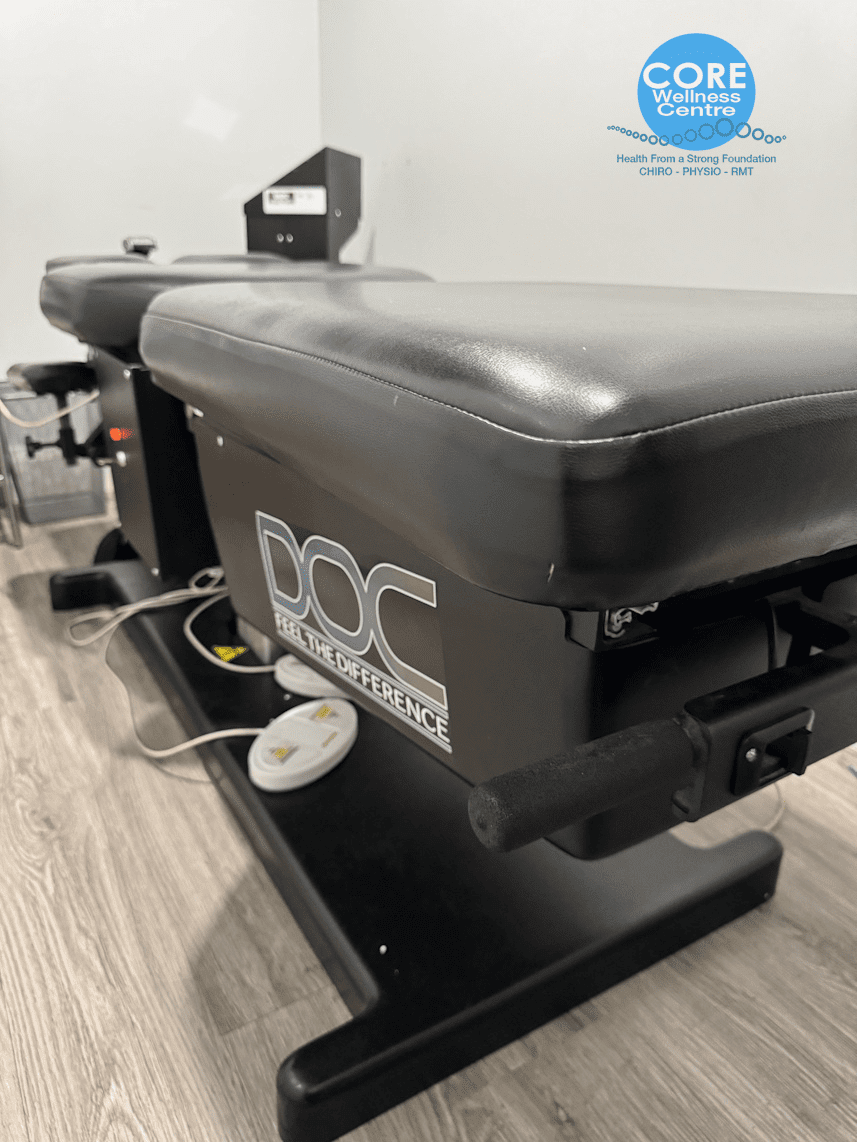
Spinal decompression therapy takes the concept of stretching the spine one step further. You lie comfortably on a motorized table that gently and rhythmically stretches your spine in a controlled, precise way.
Why does this work so well? Two important reasons:
It helps disc injuries heal from the inside. When a disc is herniated or bulging, it can press on nearby nerves causing pain, numbness, or tingling. The gentle stretching during decompression creates a small amount of negative pressure inside the disc — almost like a vacuum — that helps draw the bulging disc material back toward its normal position, taking pressure off the nerve.
It nourishes your discs. Unlike most other tissues in the body, spinal discs do not have their own blood supply. They rely on movement to absorb nutrients and fluid — similar to how a sponge absorbs water when squeezed and released. Decompression therapy replicates this pumping action in a focused, therapeutic way, feeding your discs the nutrients they need to heal.
For athletes dealing with a herniated disc, a bulging disc, degenerative disc disease, or sciatica, spinal decompression can provide significant pain relief and support real structural healing — often helping patients avoid surgery altogether.
Sports Physiotherapy — Hands-On Treatment and Exercise Programming
While Dr. Kris focuses on restoring your spinal alignment and reducing nerve irritation, our sports physiotherapy team focuses on the bigger picture — how your entire body moves and why the injury happened in the first place.
Sports physiotherapy is the foundation of long-term recovery. It goes beyond treating the pain. It finds and corrects the movement problems, muscle weaknesses, and body mechanics that put you at risk for injury — so you do not end up back on the treatment table six months from now.
Hands-On Manual Therapy
Our sports physiotherapists use a variety of hands-on techniques to reduce pain, loosen tight areas, and help your body heal:
Joint mobilization — Gentle, rhythmic movements applied to stiff joints to restore normal range of motion and reduce pain. Think of it as carefully coaxing a rusty hinge to move freely again.
Soft tissue release — Targeted hands-on pressure applied to tight muscles, knots, and areas of built-up scar tissue. This helps loosen restrictions that limit your movement and contribute to ongoing pain.
Your Personal Exercise Program
One of the most important parts of physiotherapy recovery is your customized exercise program. This is not a generic set of exercises pulled from a website. It is a plan built around you — your specific injury, your sport, your current fitness level, and how quickly you need to return to competition.
Your program is designed to:
- Restore full movement in your lower back, hips, and mid-back
- Rebuild the deep core muscles that protect and support your spine
- Fix the specific movement habits that caused or worsened your injury
- Gradually and safely increase the load on your spine so it is ready for the demands of your sport
- Build the strength, stability, and power you need to compete at your best again
Your program is reviewed and updated at every visit as you get stronger and progress through recovery. This ensures you are always training at exactly the right level — not too easy, not too much, not too soon.
The Core Wellness Centre Difference: Rather than seeing a chiropractor and a physiotherapist separately at different clinics, our team works together under one roof.
Dr. Kris and our sports physiotherapists communicate directly about your care — so your treatment plan is always coordinated, consistent, and moving you toward one goal: getting you back to your sport, stronger than before.
Soft Tissue Therapy - Cold Laser Therapy and Shockwave Therapy
Cold Laser Therapy & Shockwave Therapy | Core Wellness Centre
Advanced Treatments to Help You Heal Faster
At Core Wellness Centre, we go beyond hands-on adjustments and exercise. We also offer two highly effective treatment technologies that have helped countless athletes recover from stubborn back injuries — cold laser therapy and shockwave therapy.
Both are non-invasive, safe, and designed to work alongside your chiropractic and physiotherapy care to speed up your recovery.
Cold Laser Therapy
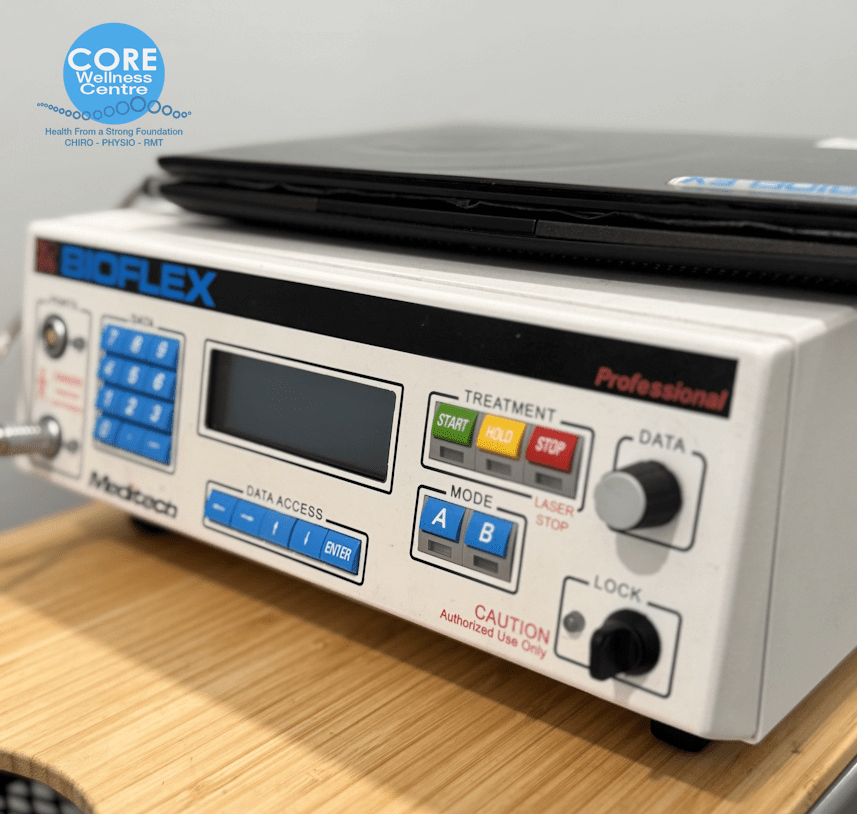
Cold laser therapy is a low-level laser (a focused beam of light) that is applied directly to the injured area. This produces no heat, causes no pain, and does not break the skin. You will simply feel the device resting gently on your skin during the session.
So how does it work?
The light from the laser penetrates through your skin and deep into the injured tissue beneath. Once there, it acts like a battery charger for your cells — giving them an energy boost that helps them repair themselves more quickly. Think of your injured cells like a phone with a dead battery. The laser gives them the charge they need to get back to work.
This process helps your body to:
- Heal damaged muscles, discs, and nerves more quickly
- Reduce swelling and inflammation in the injured area
- Ease pain naturally, without medication
- Rebuild healthy tissue in areas that have been slow to recover
Cold laser therapy is particularly helpful for athletes dealing with muscle strains, disc injuries, nerve irritation, and lower back inflammation that just will not settle down.
Sessions are quick, painless, and require zero recovery time afterward.
Shockwave Therapy
Shockwave therapy is one of the most exciting and well-researched technologies in sports medicine today. It works by delivering rapid pulses of pressure — similar to small sound waves — directly into the injured tissue using a handheld device that is moved gently over the skin.
Interestingly, shockwave technology was originally developed to break up kidney stones inside the body without surgery. Researchers later discovered that the same type of energy, applied at lower levels, had a remarkable ability to jumpstart healing in injured soft tissue — and it has been used in sports medicine clinics around the world ever since.
Here is the simplest way to understand how it works:
When an injury becomes chronic, meaning it has been there for weeks or months and is not getting better, the tissue often gets stuck in a state where healing has stalled.
The normal repair process has essentially given up. Shockwave therapy wakes that process back up. The pressure waves create a small, controlled signal in the tissue that the body interprets as a fresh injury, prompting it to send in a new wave of healing resources, including fresh blood flow and new collagen (the building block of healthy tissue).
Shockwave therapy works especially well for athletes who have:
- Lower back muscle strains that have not improved with other treatments
- Deep, stubborn muscle knots in the back that keep coming back
- Calcium build-up in spinal tendons or ligaments causing ongoing pain
- Chronic back pain that has been hanging around for months with little improvement
Multiple research studies have confirmed that shockwave therapy significantly reduces pain and improves function, particularly for chronic soft tissue injuries that have not responded well to other treatments.
How These Treatments Fit Into Your Care at Core Wellness Centre
Cold laser therapy and shockwave therapy are never used as standalone treatments at Core Wellness Centre. Instead, they are carefully integrated into your overall care plan by Chiropractor Dr. Kris and our physiotherapy team — used at the right time, for the right injury, to get the most out of every treatment session.
Think of them as powerful tools that work in the background, supporting and accelerating the work being done through your chiropractic adjustments, spinal decompression, and physiotherapy care.
Together, these treatments create a comprehensive recovery approach that addresses your pain, promotes real tissue healing, and gets you back to sport faster.
Athletes Trust Core Wellness Centre to Get Them Back in the Game. Our integrated team has helped hundreds of athletes recover from back injuries. Ready to experience the difference?
CALL us on (416) 479 – 8311 TODAY or simply book online below
Frequently Asked Questions (FAQ)
How long does it take to recover from a sports-related back injury?
Recovery time varies significantly depending on the type and severity of the injury. Early, accurate diagnosis and evidence-based treatment dramatically reduce recovery time.
Can I continue training with back pain?
It depends on the nature and severity of your injury. Many athletes can continue modified training during recovery, for example, swimming or cycling instead of running, or upper body training while protecting the lower back. Your chiropractor or physiotherapist will provide specific guidance on safe activity modifications tailored to your injury.
Is chiropractic care safe for athletes with disc herniations?
Yes, chiropractic care, particularly spinal decompression and gentle mobilization techniques, are widely used and well-supported for disc herniation in athletes. Chiropractor Dr. Kris, will select techniques appropriate for your specific presentation and avoid any approaches that could aggravate your condition.
What is the difference between a chiropractor and a sports physiotherapist?
Chiropractors focus primarily on the diagnosis and treatment of spinal and musculoskeletal conditions through spinal adjustments, decompression, and soft tissue therapy. Sports physiotherapists specialize in movement assessment, rehabilitation exercise, and return-to-sport programming. At Core Wellness Centre, both disciplines work collaboratively to provide comprehensive athletic injury care.
How does shockwave therapy help with chronic back pain?
Shockwave therapy stimulates the body’s natural healing response in chronically injured tissue by creating controlled acoustic pressure waves. It promotes new blood vessel formation, stimulates collagen production, and breaks down calcific deposits and scar tissue — effectively restarting the healing process in injuries that have plateaued or failed to resolve with other treatments.
When should I see a chiropractor or physiotherapist for back pain?
Ideally, as soon as possible after an injury occurs. Early intervention consistently produces better outcomes, shorter recovery times, and lower rates of chronic pain development. If your back pain is severe, associated with leg weakness or numbness, affects bladder or bowel function, or follows significant trauma, seek care immediately.